
Tired of Robotic AI Chatbots? Meet the More Human-Like Lyro AI Agent\" (copy)
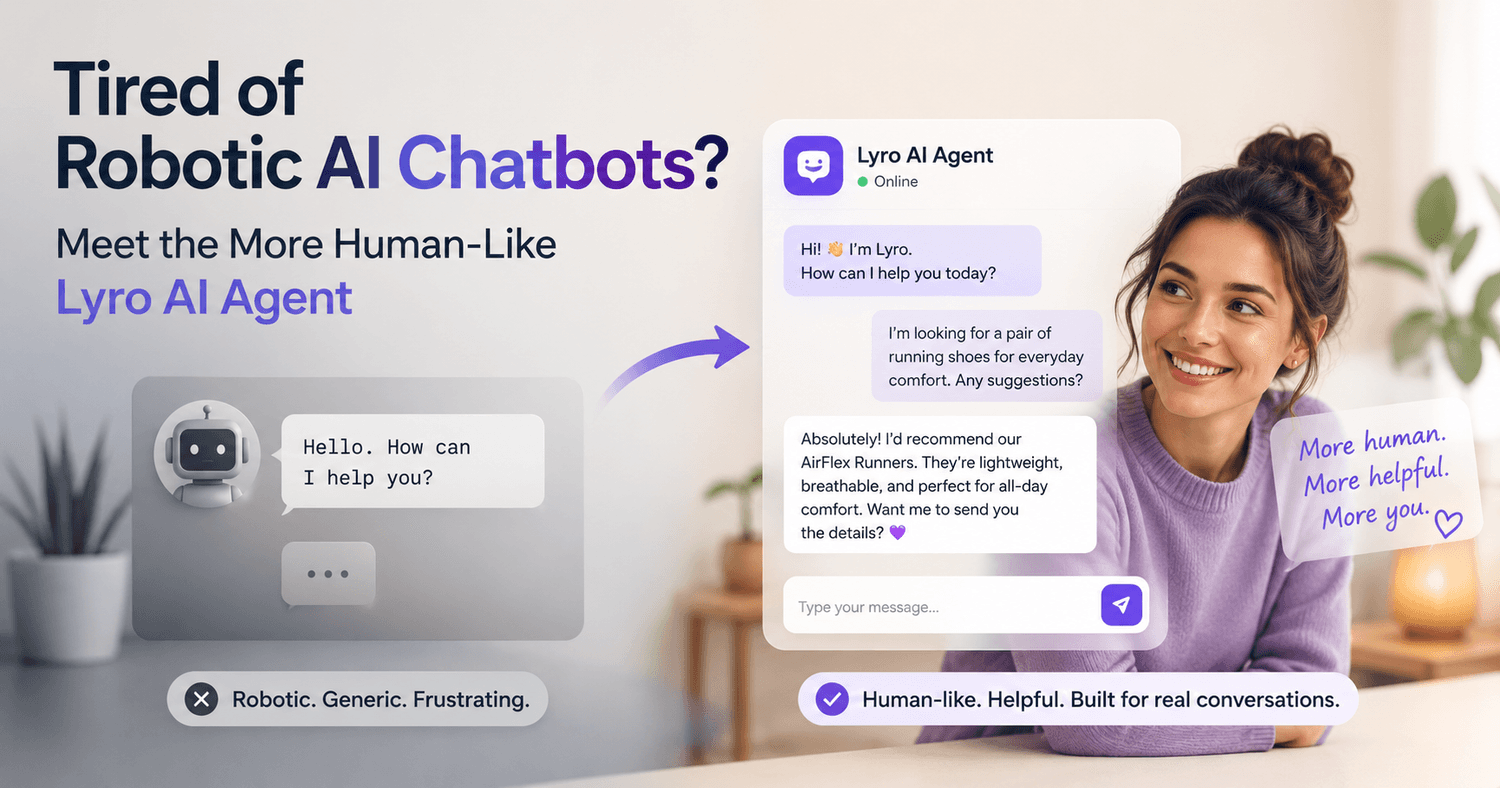
Have you ever spent twenty minutes arguing with a support bot? You explain your issue, it gives you a menu, you pick an option, and it misunderstands you anyway.
It is a common source of frustration. You want help, not a loop of pre-written answers. This is why most AI chatbots feel robotic. Lyro AI Agent feels different.
Instead of guessing what you need, this technology understands what you mean. It treats conversation as a two-way street. Most systems are just glorified search bars that force you into their way of thinking.
Lyro works with you to solve problems, making it a clear step forward for anyone tired of automated dead ends.
Deconstructing the Robotic Feel in Conventional Chatbots
Most support bots rely on old methods that fail when a user steps off a pre-planned path. They often feel cold because they were never built to hold a real conversation.
The Limitations of Scripted Responses and Decision Trees
Standard chatbots rely on decision trees. A programmer maps out every possible path a user might take. If your question matches a branch, the bot provides a canned response. If your question is slightly off, the bot breaks down.
It has no memory of what you just said, so it treats every question as if it were the first. This leads to repetitive cycles where you find yourself repeating the same information to no avail.
Analysis Paralysis: When Overly Complex NLU Fails Context
Natural Language Understanding (NLU) models are supposed to fix this, but they often fail in practice. Many systems prioritize keyword matching over true intent.
If you ask, "Why is my bill high?" the bot picks up "bill" and "high" and dumps your last three statements on you.
It fails to grasp that you are actually asking about a specific fee you do not recognize. This focus on keywords instead of meaning is why many support bots fail at first-contact resolution.
The Absence of Tone and Empathy in Standard AI Dialogue
A big part of human interaction is tone. We pick up on frustration, urgency, or confusion and adjust our language to match. Conventional bots do not have this.
They use the same tone whether you are asking for your account balance or reporting a serious issue. This lack of emotional awareness makes the interaction feel cold. It tells the user that their feelings and their specific problem do not matter.
How Lyro AI Breaks the Mold
Lyro operates differently because it does not rely on static scripts. It uses advanced models to interpret meaning in real-time, just like a person would.
Understanding True Contextual Flow
Lyro maintains context across a conversation. It remembers the information you shared three turns ago, allowing it to build on previous answers. If you are troubleshooting a complex technical issue, it keeps track of what you have already tried.
It does not force you to restart the process if you make a typo or rephrase a question. This mimics human memory and allows for a fluid, natural exchange.
Dynamic Response Generation vs. Pre-Canned Templates
Standard bots look for the best match in a library of pre-written templates. Lyro builds its own answers. It synthesizes information to provide a unique, relevant response every time.
Imagine asking a store bot, "Can I change my order?"
Standard Bot: "Please select: 1) Cancel Order, 2) Change Address, 3) Change Items."
Lyro: "I can help with that. Since your order has already shipped, I can help you initiate a return once it arrives.
Or, if you need to update your shipping address, I can contact the warehouse right now. Which would you prefer?" Lyro gives you options based on your specific situation, not a generic list.
Integrating Real-Time Data for Hyper-Personalization
Lyro does not live in a vacuum. It connects to live data sources like your CRM or knowledge bases. This means the answers it provides are accurate and up-to-the-minute.
It can see your order status, your previous interactions, and your account details. It uses this information to personalize every answer, making the experience feel tailored to you.
Measuring the Humanization of AI Interaction
You can tell when a bot is actually helpful versus when it is just going through the motions. The difference shows in the metrics.
Analyzing Key Performance Indicators for Conversational Depth
To humanize AI interactions effectively, companies must look beyond simple task completion. They should track metrics like reduced turn-taking frustration and increased task completion without human handoff.
When a system understands the user, the user does not need to ask the same thing five times. They get their answer and move on. These interactions show a clear drop in user friction compared to older, rigid systems.
Solving Complex, Multi-Step Problems Naturally
Think of a process like changing a flight booking with multiple legs. A standard bot sends you to a FAQ page or a human agent.
Lyro can take the request, check the ticket rules, offer alternative flights based on live availability, and handle the change request directly.
It navigates these multi-step processes without forcing the user to return to a main menu or wait for a person to type a response.
The Role of Proactive Clarification and Anticipatory Dialogue
Humans ask clarifying questions when they do not understand. They also anticipate what might be needed next. If you ask about a feature, Lyro might say, "I can explain how that works.
Do you want the technical details or the simple overview?" By offering choices, the bot demonstrates that it understands your intent. This approach turns a reactive, robotic bot into a helpful assistant.
Implementing Lyro for Superior Customer and Employee Experiences
Adding this technology is not just about replacing a script. It is about changing how your business talks to people.
Where Natural AI Yields Maximum ROI
The greatest impact happens where conversation matters most. This includes high-stakes customer service, specialized internal IT help, and complex sales inquiries.
In these areas, the ability to understand nuance prevents escalation and saves time. If your current bot is struggling with complex queries, this is the area where you will see the fastest improvement.
Actionable Steps for Seamless Transition to Human-Like AI
Look at your current bot logs. Find the exact points where users give up or ask for a human. These are your "failure points."
Prepare Your Knowledge: Organize your knowledge base. Lyro needs clear, accurate information to draw from. If your documents are outdated, the bot will be, too.
Define Your Brand Tone: Decide how you want the bot to sound. You can train Lyro to be formal, casual, or anywhere in between.
Start Small: Test the agent on one specific process first. Use the feedback to adjust its tone and knowledge before rolling it out to more complex tasks.
Future-Proofing Conversational Interfaces
The standard for digital support is changing. As users get used to more natural, intelligent interfaces, they will have less patience for rigid, robotic ones. Investing in natural-sounding AI is not just about fixing a support issue; it is about building trust.
When a brand respects a customer's time and intelligence, that customer is more likely to return.
Conclusion
The failure of older chatbots comes down to rigidity and a lack of context. They cannot hold a real conversation, so they force users into an artificial structure. Lyro AI Agent changes this by prioritizing understanding and fluid exchange.
It can remember, adapt, and provide specific answers based on live data. Users will no longer tolerate robotic interfaces when human-like fluency is achievable. The shift is already happening, and those who adopt this approach will set the new standard for excellence.
SHARE


Subscribe now.
Sign up for our newsletter to get the most interesting stories of the day straight to your inbox before everyone else
© COPY RIGHT 2026 smartaffiliatestore All Rights Reserved • Privacy policy • Terms of service